


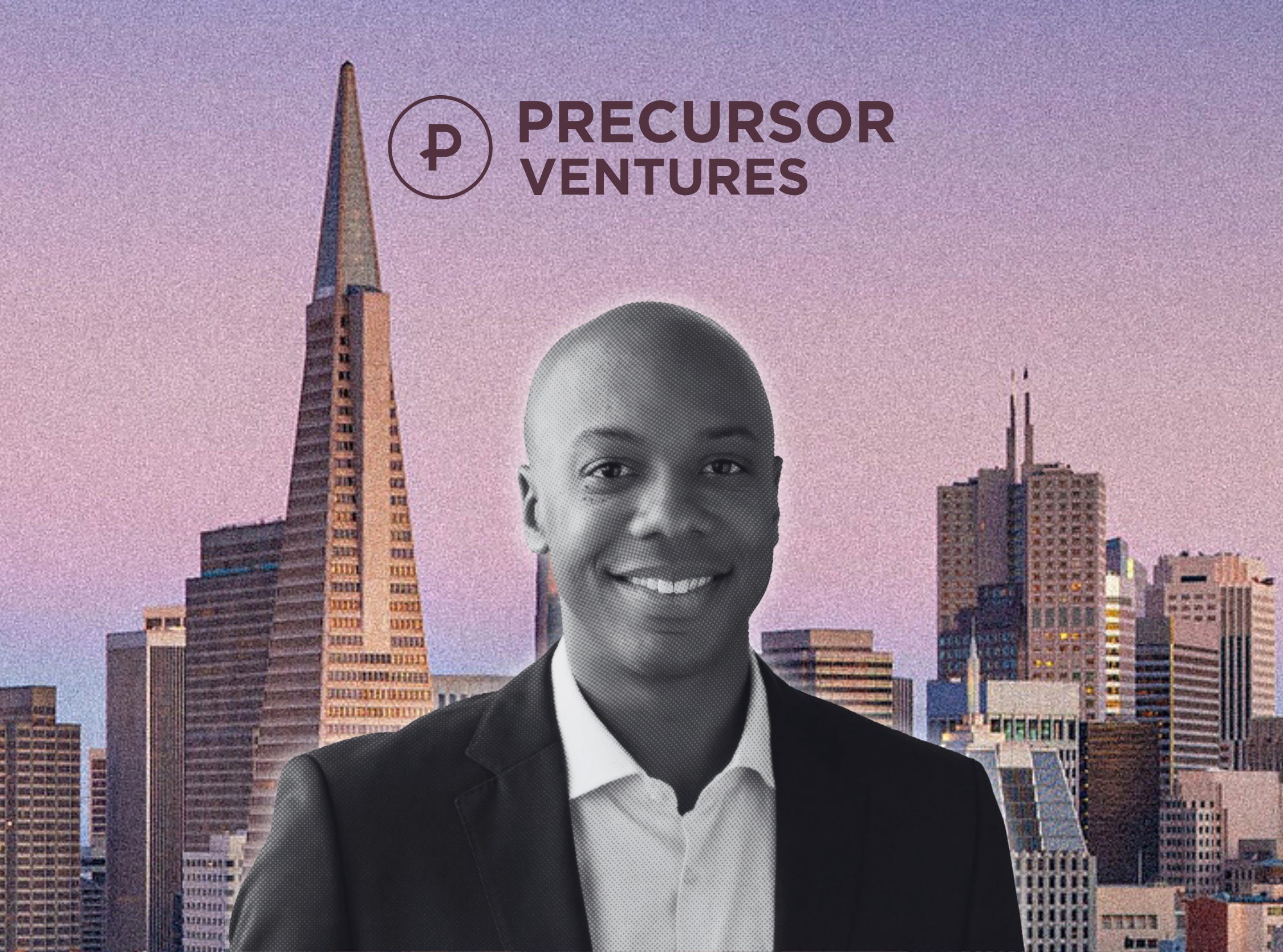
Connect with Charles
https://www.linkedin.com/in/chudson/
Charles Hudson has a simple theory about where venture capital goes wrong. The best opportunities, he believes, are not hiding in plain sight. They are standing outside the room, unable to get a meeting.
Charles founded Precursor Ventures in 2014 after leaving Uncork Capital, then called Soft Tech, where he had helped back Fitbit, Poshmark, Postmates, and Eventbrite. The financial returns from those early funds gave Uncork the runway to scale significantly, eventually reaching a fund size near $400 million. But as the firm grew, the model changed. Concentrated checks, more board seats, and founders further along. Charles understood why. He just did not want to do it.
“In order to do the kind of work I wanted to do,” he said, “I was going to have to be in a much smaller firm focused on writing those early checks.”
So he left, set up Precursor with a target of $15 to $25 million, and started writing 75 checks per fund to companies most institutional investors would not touch. Eleven years later, the math, as he puts it, feels like it has worked out.
The Uncovered Profile: Charles’s Ideal State
Picture Charles somewhere in Hawaii, a glass of white burgundy nearby, or a Chablis if the afternoon has that kind of ease to it. A Chelsea football match is on a large television, loud enough to feel like you’re right there. His family is around him, his nine-year-old son somewhere in the house, most likely settled into one of the audiobooks he plays through the Sonos system Charles has come to rely on for keeping the household running without interruption.
During the workday, a physical device called Brick sits between Charles and the apps that would otherwise compete for his attention. LinkedIn, Instagram, Threads, and anything else he describes as “doom scrolly” are blocked during working hours by a hardware profile he cannot easily override in the moment. He did not realize how much time he was losing to mindless scrolling until he removed the option entirely. The same intentionality runs through how he thinks about capital, people, and time. Nothing idle. Everything placed with care.
The First-Time Founder Thesis
Charles’s most consistent conviction is one that much of the industry has moved away from: first-time founders are worth backing, and backing them early is worth the ambiguity.
Roughly 70 percent of Precursor’s portfolio companies are started by people who have never done this before. They have not managed budgets. They have not hired or fired anyone. They may not have a product. What Charles is trying to assess is something harder to observe directly.
“How much latent managerial upside and entrepreneurial talent does this person have that hasn’t been utilized in their previous career?” is the question he asks himself when a founder is in front of him. He is, by definition, making forward projections about people who have not yet been tested in the role they are about to take on.
The trait he values most is prior experience in a zero-to-one environment, though he is careful about what that means. It does not require a previous startup. He has backed people who started nonprofits, who led community organizations, and who built things informally. The relevant variable is whether they have opted into the chaos of creating something from nothing, and whether they are prepared to opt back into it.
Domain expertise is relevant roughly half the time. The other half of Precursor’s companies have been started by what Charles calls naive outsiders, founders who looked at an industry without the accumulated assumptions of someone who grew up inside it. In regulated markets, he finds this particularly valuable. People who know all the rules have often internalized those rules as constraints. People who are only vaguely familiar with them sometimes find creative paths that insiders never consider.
The portfolio example he returns to most often is Pair Eyewear, an eyeglasses company he backed when its two founders were 22 years old and freshly out of Stanford. A decade later, they are still running the company, which has scaled to a meaningful revenue level. No management changes are planned. Charles describes this arc as emotionally satisfying in a way that is distinct from a rapid return: finding someone raw and watching them build a sizable business over 10 or 15 years.

The Fund Within the Fund
Precursor’s model is built around a simple but underserved gap. About 60 percent of its activity goes into classic pre-seed rounds, defined as a company’s first investment of $1.5 million or less. Another 25 to 30 percent covers seed rounds in the two- to four-million-dollar range. The remaining 10 percent is a buffer for deals that are simply more expensive, such as a recent investment into a company raising a ten million dollar round at a 40 million dollar valuation, led by an unnamed multi-stage firm, alongside a founder Precursor had previously backed.
The fund’s investment team comprises five people: Charles, three principals, and an associate, with support at any time from two graduate interns. Charles is the sole general partner.
What makes the structure unusual is how he uses authority. A few years ago, Charles gave each principal a dedicated pool of capital they could deploy without his approval, subject to the fund’s LPA guidelines. The explicit goal is to filter for taste, not to teach a framework. If a principal wants to write a check larger than their individual ceiling, they involve Charles, and the deal requires his input. Otherwise, the call is entirely theirs.
“Whatever you pick is what you pick,” he told his team. The result is that the portfolio reflects genuinely distinct sensibilities. One team member turns over high volume, meets many founders, and moves quickly. Another is selective, rarely takes a first meeting, and moves slowly. Both are producing results.
No Standard Mold
Charles has never run a conventional fund and shows little interest in starting. Precursor’s portfolio includes an infant formula company, a women’s ski wear brand, a dog boarding concept that inverted the traditional hotel model, a space communications investment, a nuclear energy company, and what he describes as a “dating glow up” company started by someone he has known for years.
He connects this openness partly to a career that has moved between very different organizational contexts. Before and alongside Precursor, Charles has been involved with In-Q-Tel, the San Francisco Opera, and his alma mater, Stanford, among more than 40 listed engagements. He is candid about not being especially good at stepping back from commitments once he has made them.
What this breadth has given him, in his telling, is a better understanding of how non-startup organizations operate. When portfolio companies sell into universities or government agencies and find themselves frustrated by the pace, Charles can explain why. Those institutions are not broken. They are optimized for different things.
He extends this sensibility to software at large. His view on AI is more restrained than the current enthusiasm suggests. He is long-term constructive on the technology, but believes many of the first-generation application companies are paving a road that others will travel rather than capturing the bulk of the value themselves. His more pointed concern is structural. AI, in his view, is deflationary for software. It shifts value from vendor to consumer in a way the industry has not had to account for before. Products that cost $1,000 today may cost $100 in two years and perform better. Pure software businesses, he believes, face a harder long-term equation than most current valuations reflect.
Playing Their Own Game
Charles is direct about the deliberate choice at the center of Precursor’s model. The current moment in venture has concentrated an unusual share of the industry’s capital in the hands of a small number of large firms. Andreessen Horowitz, Sequoia, Index, Lightspeed, and their peers effectively anoint which companies matter, and a meaningful portion of the industry calibrates its judgment by what those firms choose to pursue.
Precursor sits outside that system by design. The companies Charles is writing checks into are nearly always too early, too unconventional, or too outside established networks to attract attention from large funds whose minimum ownership requirements and fund sizes require a different kind of opportunity. He is clear-eyed about what that requires from him and his team.
“You’re just going to be unpopular for long periods of time,” he said, describing what it means to operate outside the current consensus. “Because many of the things we’re doing are not in the sweet spot of the biggest firms in our industry.” The key, in his view, is understanding which game you are actually playing. Strategies that work for a 250 million fund do not necessarily translate to a multi-billion-dollar platform, and vice versa. Copying a model without understanding its underlying mechanics is a risk in itself.
His advice to the founders he backs mirrors his own position. Have a point of view. Exercise good judgment about what actually matters in a fast-moving environment. Stay adaptable without treating every announcement as a signal worth chasing.
The people he is looking for, at whatever stage they are at, share something simpler. When he asks whether they have found product-market fit, he does not reach for a metric. He asks whether they are up at 11 p.m. because they are anxious and searching for an answer, or because the demand they have created can barely be managed.
Chasing a rock downhill, he calls it. That is the feeling. You can barely keep up.
More from Uncovered Media


