


When Nichole Wischoff posted an opening at her fund, Neal Mintz reached out to a dozen people who knew her, sent her an Airtable with 10 actionable deals aligned with the thesis, introduced her to several of the companies, and offered to set up her CRM. That was his application. Business Insider wrote about it. People called him a try-hard. He started as a Senior Associate in September 2024. A year later, he was VP.
Neal’s career journey is a story about proving yourself through work instead of credentials and treating every interaction like it matters. It’s also about learning to live with the fact that venture capital’s feedback loops mean you might not know for years if any of it paid off.
Meet Neal Mintz and Wischoff Ventures
Wischoff Ventures is a $50 million pre-seed and seed fund (Fund III) focused on the automation of the real-world economy, spending most of its time in legacy B2B industries across money, movement, manufacturing, and marketplaces. Managing Partner Nichole Wischoff runs the San Francisco side. Neal covers New York. That’s the whole investing team.
Nichole built the firm’s thesis from operator experience. She was early at Blend, part of the founding team at One Finance, and joined construction tech company Built before it reached the growth stage. She started angel investing off that network, raised a small Fund I, a more institutional Fund II, and closed Fund III at $50 million.
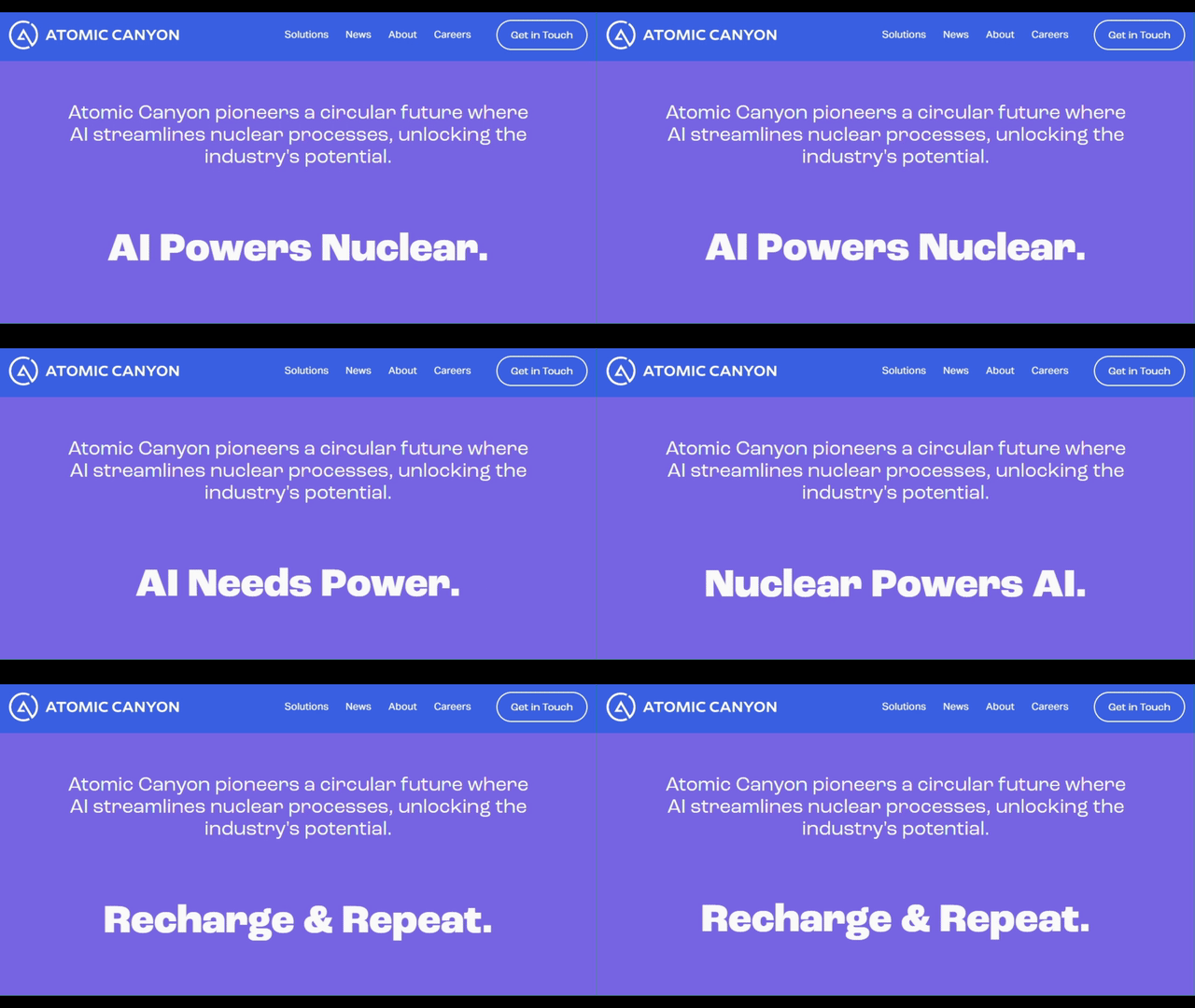
The fund writes $1 to $2 million checks, targeting around 10% ownership, usually as the first institutional check in. Current areas of focus include AI-enabled rollups in legacy industries, where companies are building AI-powered versions of services businesses rather than trying to sell software to slow-to-change incumbents. They’re also spending time in critical minerals and mining, and energy infrastructure, where portfolio company Atomic Canyon is building vertical AI for nuclear energy facilities to address the generational knowledge gap as veteran workers retire.
Forging The Path
Neal always had an interest in building businesses and understanding how they scaled. He was the kid in middle school with a duct tape wallet operation. He commuted two hours each way to high school and couldn’t work a formal job, so he started an eBay business. He was president of the entrepreneurship club. The instinct was always there. The exposure to venture was not.
That changed during a couple of summers in Tel Aviv in 2017 and 2018, where he worked in a startup consulting role during the blockchain wave. Watching companies raise capital quickly and make real impact in their industries rewired how he thought about business.
“My perception prior was that the business world is very slow moving. Startups are really the catalyst for meaningful and positive change. Venture is the vehicle that enables them to grow.”
After graduating from Washington University in St. Louis, he spent a year and a half in consulting to understand the inner workings of these sleepy Fortune 500s before leaving to join Fractal Software, a venture studio in New York, where he helped launch B2B Vertical Software Companies. From there, he moved to Ground Up Ventures for a two-year associate program. He was close to leaving for an operating role when Nichole posted the opening.
“I recognize that at a small fund. You’re going to have to be willing to do whatever it takes to help us succeed.”
That philosophy shapes how he thinks about anyone trying to break into venture. The most defensible part of the job is relationships and deal sourcing, especially at the pre-seed and seed stages where companies have no digital presence. “If you just say, ‘Hey, I’m great at diligence and I can research a startup,’ there’s a lot of folks with that same level of intellectual horsepower,” he said.
“It’s the ability to relationship build and be intentional about how you’re doing so in a way that’s adding a ton of value for the firm.”
Automate the Machine, Not the Relationships
Neal is automating as much of his job as he can. Operational tasks like syncing Granola notes with his calendar, email inbox, and HubSpot CRM. Preliminary diligence research like mapping out competitors, their funding, their founders, and their headcount (tasks that used to take hours) now take one prompt. What he won’t automate is anything involving relationships. Outreach, follow-ups, and especially pass emails.
“Treat pass emails with the same level of thoughtfulness as initial outreach.”
He credits Nichole with that advice. He speaks with about 50 companies a month. Wischoff might do one deal a month. That means a lot of passes, and Neal sees everyone as an investment in his network. “The flywheel from those relationships end up paying dividends because I stay top of mind,” he said. “What better way to meet early-stage founders than through founders themselves?”
It connects to a broader principle about reputation in venture.
“It takes one bad conversation to completely destroy your own reputation or get grilled on social media. Whether or not it’s deserved, it’s very important to represent yourself and the firms you’re working for very well.”
The same values show up in how Wischoff works with portfolio companies after investing. Neal’s text messages are half portfolio founders asking for help with office space, hiring, product direction, or financial models. He described a recent night when a San Francisco portfolio company needed help building out their financial model for a seed raise. Neal, in New York, got on the line at 11 p.m. and stayed until 2 a.m. “It’s just our mentality towards everything,” he said.
The Part Nobody Talks About
“I love this job, don’t get me wrong, I have the best job in the world, but it is not always glorious. You are working incredibly hard to meet founders, to chase founders, to diligence opportunities and get a deal done. And very often the deal doesn’t happen for one reason or another.”
Someone else moved faster. Someone else was a better partner. The price didn’t work. You couldn’t convince your team. “You have to be willing to pick yourself back up and keep grinding and working hard,” he said.
The deeper challenge is the feedback loop. In venture, you make an investment and you won’t know for three to five years if it was a great one. The industry operates under the power law, where one or two investments produce the majority of a fund’s returns. If you’re relatively junior and doing roughly one deal a year, the sample size is brutal.
“It’s really hard to know whether or not you’re an exceptional investor early on in your career because of the elongated feedback loops. The likelihood that you find that outcome that ends up returning the fund is very, very slim, and it could be very disheartening.”
He drew a parallel to startup fundraising. VCs put enormous work into deals that fall through, just like founders put enormous work into pitches that end in rejection. But he was honest about the comparison. “I would be lying to myself if I didn’t say startups have it more. They’re in a much more difficult seat because they’re getting a lot more nos.”
It’s the same standard he holds founders to. “They’re raising for the sake of raising when they haven’t gotten themselves to conviction,” he said. Wischoff wants to see that a team has done everything in their power to scale the business before looking for capital. No revenue threshold, no specific milestone. Just proof that the founders have moved as fast as they can with what they have.
It all circles back to the same idea Neal started with: do the work before you have the job, keep doing it after you get it, and understand that the results might take years to show.
“If you want to break in, you have to do a lot of extra work that you’re not going to get paid for. You have to do as much of the job as you can before having it.”
More from Uncovered Media


